Category Archives: some writing

seeing is one thing; feeling it is knowing

I first came in contact with visuality, the word, on 11/09/2023, during “Birth: A Convening on Art and Human Reproduction” at the New Museum. Of course, visuality had been a guiding and deciding force in my life all along, but like the frog in a pot, I didn’t know what I didn’t know.

The birth convening was part of Judy Chicago: Herstory exhibition programming, on view at the New Museum from October 12, 2023–March 3, 2024. The exhibition filled the museum in an effort to “trace the entirety of Chicago’s practice” – what a pleasure to move through room by room (you can view installation images here). This panel focused on one project from Judy Chicago’s sixty-year career: The Birth Project.

“Why were there no images of birth?” This question inspired Judy Chicago to launch The Birth Project (1980-85). For five years, she studied creation myths, surveyed women about their birthing experiences, and produced an iconography of birth imagery across drawings, paintings, and collaboratively embroidered textiles. Now, forty years later, this convening revisits Chicago’s “awe, terror, and fascination” with birth, exploring this critical area of research and artmaking through a contemporary lens.

The panelists, Ani Liu, Carmen Winant, Dána-Ain Davis, and Viva Ruiz, in a mix of slide presentations and conversations, (moderated by Alethea Rockwell), discussed birth, abortion care and access, medical racism, maternal care in terms of visuality.

  • What is the impact of the images that make it through?
  • Who and what are missing from view?
  • What is the impact of absence?

And I felt it: seeing is one thing; feeling it is knowing.
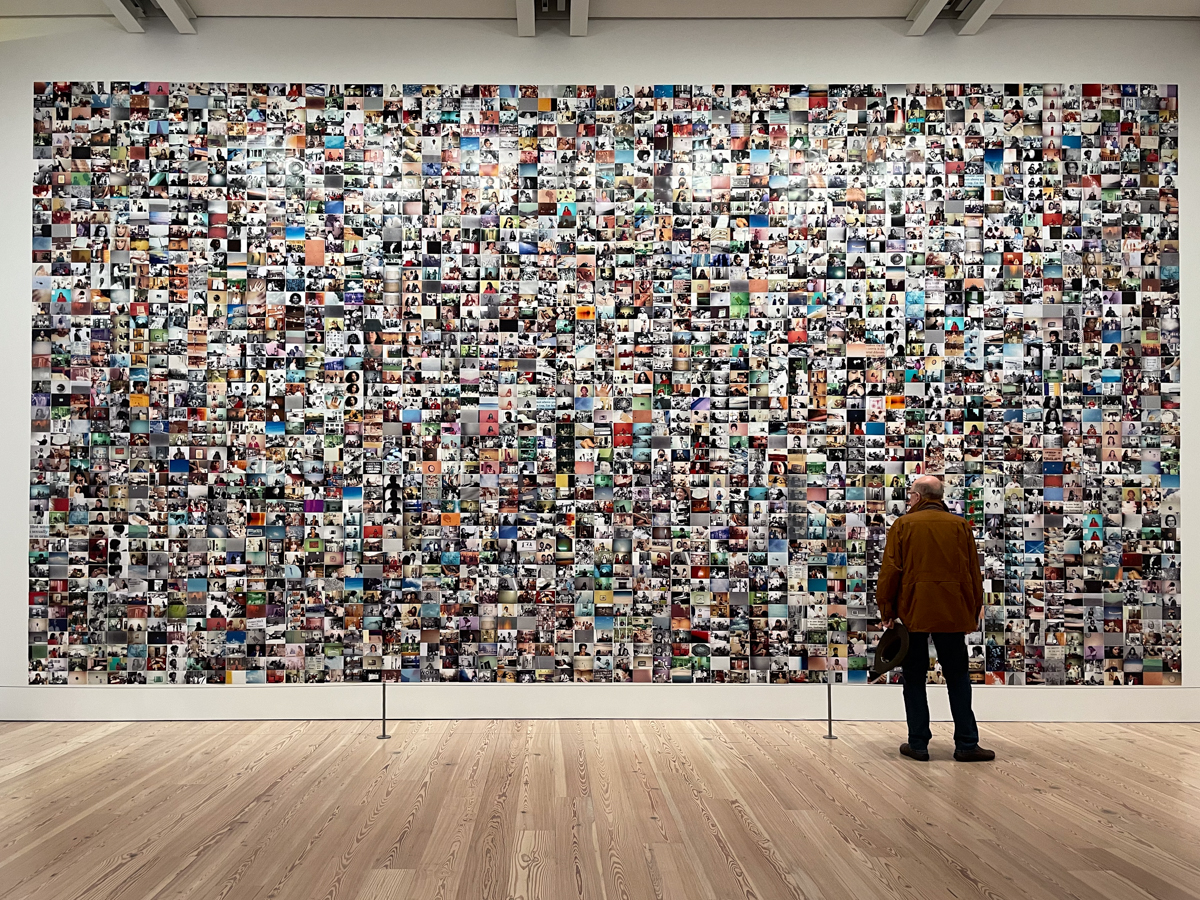
An end-to-end view of Carmen Winant's "The Last Safe Abortion", installed at The Whitney Museum. A man is standing in front of the several thousand images, mainly of women on the phone, doing office work.
An end-to-end view of Carmen Winant’s The Last Safe Abortion, installed at The Whitney Museum. A man stands in front of the wall of 2,500 images, mainly of women on the phone, doing office work.

Did you know that this is what abortion work looks like? I didn’t. I hadn’t really thought about it: the images I was being fed, what it would take to run a healthcare practice.

Women on the phone, answering questions, making appointments.. Makes sense.

I see that now.

Visuality

Which images we see, in what context(s), and with what frequency, visuality defines our cultural landscape and social norms.

You don’t feel it happening.

It feels like a given.

Even when it’s inaccurate, even when it’s incomplete, even when its claims undermine your lived experience, what we see shapes our understanding, our expectations, our beliefs.

What showed up, what gained access, what got repeated: becomes part of the landscape – internally and externally. It takes shape in our minds (O, that’s what that looks like?), and shapes our minds (I know what that should look like).

It takes shape out in the world (O, that’s what that looks like?)OK, let’s maintain it. –No, let’s get rid of it.

Visuality is not a given.

How we come to see what is true about the world is generated by many decisions along the way.

Visibility

Visibility is a feature of power. It fosters credibility and reinforces authority. Repetition is powerful. It can override what you know, overwhelm your ability to say so, or even to ask a question.
room to breathe

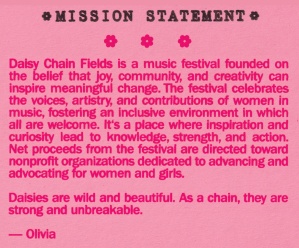
The other day, I read a newsletter article about Daisy Chain Fields, the music festival that took place last weekend in Irvine, CA, and the author, Jessica Valenti, said this about what it felt like to be there: “In a country determined to suffocate us, Daisy Chain gave women room to breathe.”

..room to breathe

giving women room to breathe.

I can’t stop thinking about it: what that must have felt like: so many people. all that safety. When was the last time I felt that in a public space? paid place or free to enter. The curiosity and interest, the basic joy of being, that moves among us when there is room to breathe. When? Where was I?

room to breathe

for women

in a male-unless-otherwise-indicated world —

is not just a liberatory experience.

To generate space where you can let go of vigilance, of anticipation, of your personal knowledge about the inherent possibility of attack based on gender, on simply being female that we all live with, and feel yourself in the midst of room to breathe:

is an act of imagination

a sacred space of celebration

of being alive.

I wasn’t there, but I’m inspired. Just reading it, I began breathing it in, found myself full-body imagining it: what it must have felt like: so many people. all that safety.

room to breathe.

—-

References and treats


Jessica Valenti: Abortion, Every Day newsletterIG pagewebsitebooks

Daisy Chain Fields: IG pagewebsite

Daisy Chain Fields mission statement screenshot

The body, an instigator of questions

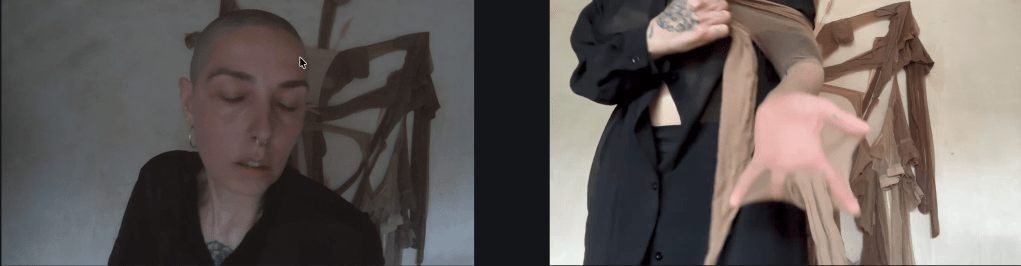
“The body, an instigator of questions”, she said. I was listening to, watching through two screens displaying one room, Dyana Gravina performing inside of it, for us. “Welcome, I can’t see you, but I know you’re there.”

Screenshot from Dyana Gravina’s emergent performance during "Artists Talk with artist Dyana Gravina", a Feminist Lecture Program x SLQS Gallery collaboration, June 17th, 2026.
Screenshot from Dyana Gravina’s emergent performance during “Artists Talk with artist Dyana Gravina”, a Feminist Lecture Program x SLQS Gallery collaboration, June 17th, 2026.

“The body, an instigator of questions”, she said. And I —

An instigator. of questions.
Questions?
Not answers?
No, answers are stopping points. destinations.
And then what?

The body is active and so, there is always more: to consider, to wonder about, to try. to feel. Questions are openings to move into, to shape ourselves to fit into: to feel the edges of the shape, to feel the edges of ourselves. What was that?

Often there isn’t time to ask.

The body, an instigator of questions. Saying it feels like a question, like an opening, following on an exhale, slowing things down, making room for the next [breath]. an invitation.

I think that’s because we’re speaking of the body, not at the body. Listening for it. We’re in relation to the body: as subject, as agent, as knowledge bearer. And mysterious: because we speak so little of its language.

I don’t mean mysterious in a romanticized way.

There simply are many, many things about how our bodies work that we don’t understand. And misunderstand. Many people are in pain, discomfort, silenced. Questions are being asked by doctors, nurses, scientists, pharmacists. legislators. caregivers. And over time we learn. Course correct. sometimes. Discover. sometimes. Obscure. how often?

Questions have a source. And a perspective, a history. And a desire. Often these are multiple, mixed, and not necessarily clear to the bearer of them, or to us in the room. In the doctor’s examination room, our employer’s office, on the street, in our homes, in the places where we provide care to children, grandparents, parents, neighbors, where we try to take care of ourselves.

Who is asking and why?

What do they desire for us, for themselves?

What does your body want?
If you could understand it..

“The body, an instigator of questions”.

When Gravina said that. I felt it.
I felt myself a body. a woman. an instigator of questions.

—-

References and treats


Artists Talk with artist Dyana Gravina was a collaboration between The Feminist Lecture Program x SLQS Gallery. << Thank you! I am so fortunate to have been there!

Recordings of The Feminist Lecture Program artist talks (and lectures!) are available here. << So, you can see it too!

INSTAGRAMs: @dygravina @thefeministlectureprogram @slqsgallery
WEBSITEshttps://dyanagravina.com/ https://feministlectureprogram.com/ https://www.slqsgallery.com/

Celebrating Menstrual Hygiene Day

Last Thursday, May 28th, was Menstrual Hygiene Day. I discovered it on LinkedIn (thank you, Aunt Flow for that). Initially, it surprised me, but then I felt it: things are changing. Even when the backsliding and brutality feels like that is all there is: things are changing, always changing.

What could be more normal than to celebrate the proper, equitable, and fun care and maintenance that supports about half of humanity’s day-to-day experiences for a good portion of our lives?

It’s not like we can separate our bodies from our work lives or our work minds. Though, we do try. We push past complaints, ignore signals, and relegate our body to tool status, one rung lower than a large language model. It’s been the cultural norm as far back as I can remember, or read about it: mind over matter. Bodies, landscapes, animals, insects, rivers, trees. We are meant to be their masters. Or, so I’ve been told. In so many ways.

Though, I challenge anyone to tell me that they’ve ever actually succeeded in ruling their bodies. The drivers making their way in the usual, city traffic last night, rage-honking as if in a life-and-death battle, remind me that even men can’t do it.

Though, why should they?

Our bodies are the source of our relationship to the world, to each other, to ourselves. They hold histories and memories and the capacities that enable us to make plans, play, experience the present, and imagine the future. They make the lives we live, and the ones we dream of, possible.

So, what are we thinking?

I don’t believe in mind over matter. It is a battle you can never win: you can’t stop yourself from feeling things, and I would argue that this is a good thing because it means you’re alive. The feelings come first (bodily sensations and emotions), and then the interpretations and the opportunity to choose what you’ll do.

The body comes first. This is how it is. And yet, so much goes into maintaining this idea that bodies are to be ruled.

Especially, women’s bodies. Girl’s bodies. Nonbinary bodies.

Deem our interests as niche. Keep us separate, covered, hidden. Legislate our autonomy. Don’t provide us with basic healthcare. Deny our truths.

And definitely don’t celebrate Menstrual Hygiene Day.

But — I want to. And I just love that I was invited to celebrate in a LinkedIn post! Things are changing. It’s still brutal out here. I have no urge to deny it, or avoid feeling it, or grieving our losses. I want to talk about it. I want to celebrate our normal, bodylife experiences because that will activate more change. More awareness, more education, more connection, more exhales, more change. And more joy.

This year, to celebrate Menstrual Hygiene Day, I attended Aunt Flow’s Period Party at Xanadu Roller Rink in Brooklyn, NY.

Aunt Flow turned the personal (and commonly experienced) frustration of suddenly getting your period in public into a revolutionary business. Aunt Flow enables schools and businesses to provide free period products in their bathrooms – just like toilet paper! You can find Aunt Flow period products in places like Google’s NYC headquarters and several clubs in Major League Baseball (MLB) including the Tampa Bay Rays, and the Chicago White Sox.

Some skated and others helped pack 200 one-month period supply kits (20 Aunt Flow pads and two Stall Mates flushable wipes) to donate to Her Village Inc. Some did both 🙂

I received my period product packing training from a young girl (girl bosses are the best!), and chatted with a rotating crew of friends, partners, and team Aunt Flow, while joyful skaters zipped by around us.

Maybe all pick-pack-ship operations should play fun music and surround their people in pink lighting? Certainly changing the world should be this fun and full of love. So many things we can learn from Aunt Flow.

The joy-energy was palpable. I still feel it.

Happy Menstrual Hygiene Day, everyone 🩸✨

How shall we celebrate next year?

feeling the importance of place

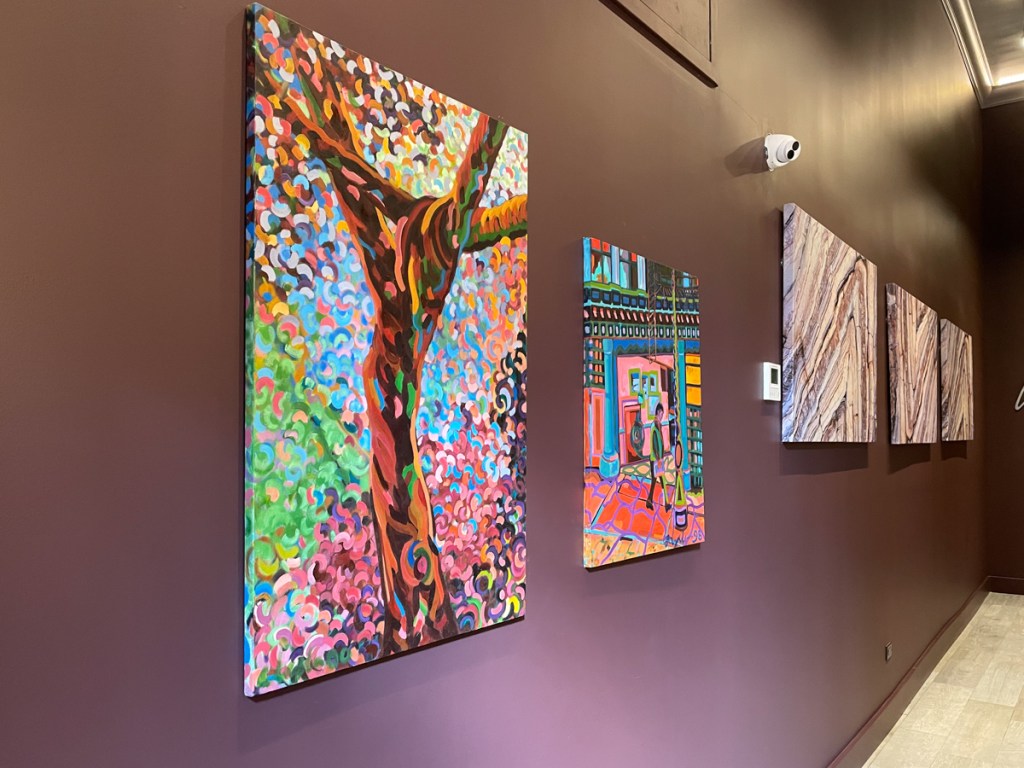
The site of these pieces here makes me so happy. People should be seeing more art. It reminds you to feel, to feel your way. For me, when I experience art that moves me: it’s a connection ritual. I remember. Even when it’s something I have never seen before, it is a re-membering, a connecting me back to my larger self: to a wordless place where being alive is enough. Proof of worth. The path forward. The way home.

It’s only recently that I’ve started thinking about – no, feeling the importance of place. Of place as a core relationship, and as the basis of all relationships.

And while there’s a there over there. And a here that is different than there, that is familiar, or mine. Or is me, where I stand. And from here, I see you where you stand. Where exactly is the edge, the border between?

If we stood here looking at these two paintings on the wall, we would be sharing breath, and of course the room. Sounds of others talking low, light music, smells (spa smells!) — And we both got here somehow. Came from somewhere, traveled on streets, on a bus or in a train probably.

There too, we were always somewhere.

It was never just us traveling alone.

It’s not just that we aren’t alone because there’s always someone around in the city. It’s the integral nature of where you are, and how you got here / there, to who you are that I’m trying to get at.

I mean the river can’t exist without the river’s edge —and more of course, it’s made and remade by the weather, and by the beings who use it, keep it alive, make it what it is, participate in what it becomes.

It’s the same for buildings on blocks in neighborhoods (which by the way, in NYC, have no official boundaries). And people. We are made and remade out of our particular relationships to a place — to the beings who use it, the forces that act on it. Its shapes, activities, and vibes shape us.

Yes, there’s still a you. You don’t need me to tell you that (actually, you are a place, and are comprised of internal places).

What I’m pointing to is the aliveness and exchange happening: the contamination. Where you are is not a background to who you are. It’s part of who you are, actively involved. You can’t strip it out. It’s like the air passing between us when we stood here looking at these two paintings on the wall.

You’re you, and I’m me, but also where is the border between us, or for that matter between you and where you are right now?

Nothing happens nowhere. Everything is situated. Every experience, idea, truth are all happening in relationship to place. But it’s not static, which can make it hard to notice; it moves -with you as memory, and becomes part of other experiences and ideas you carry. It’s taken up by others (or silenced). Even absence is tied to place.

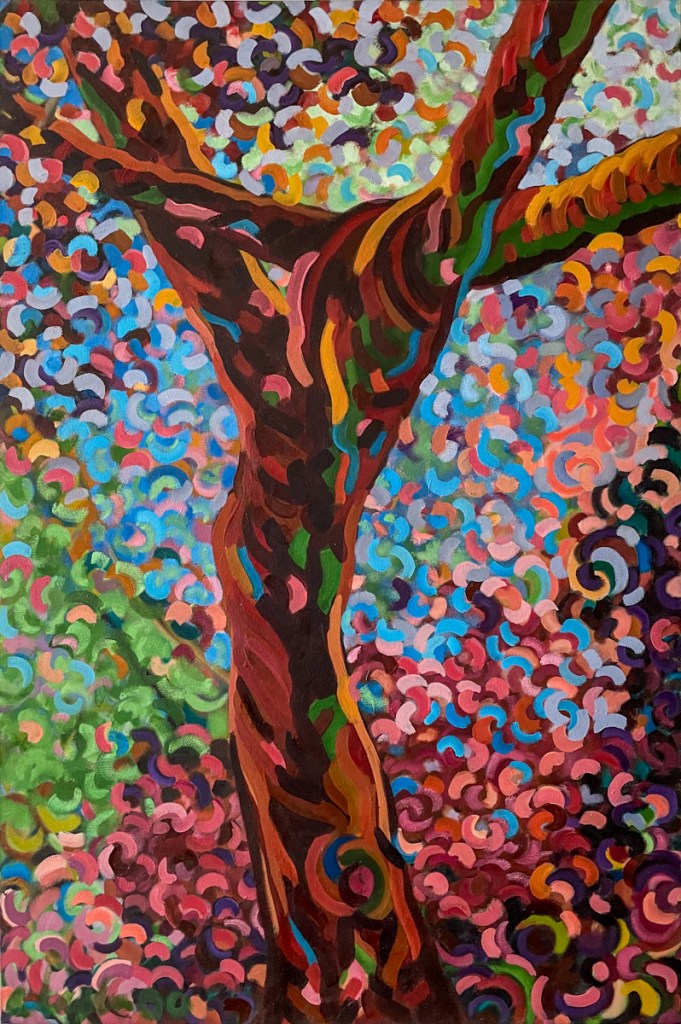
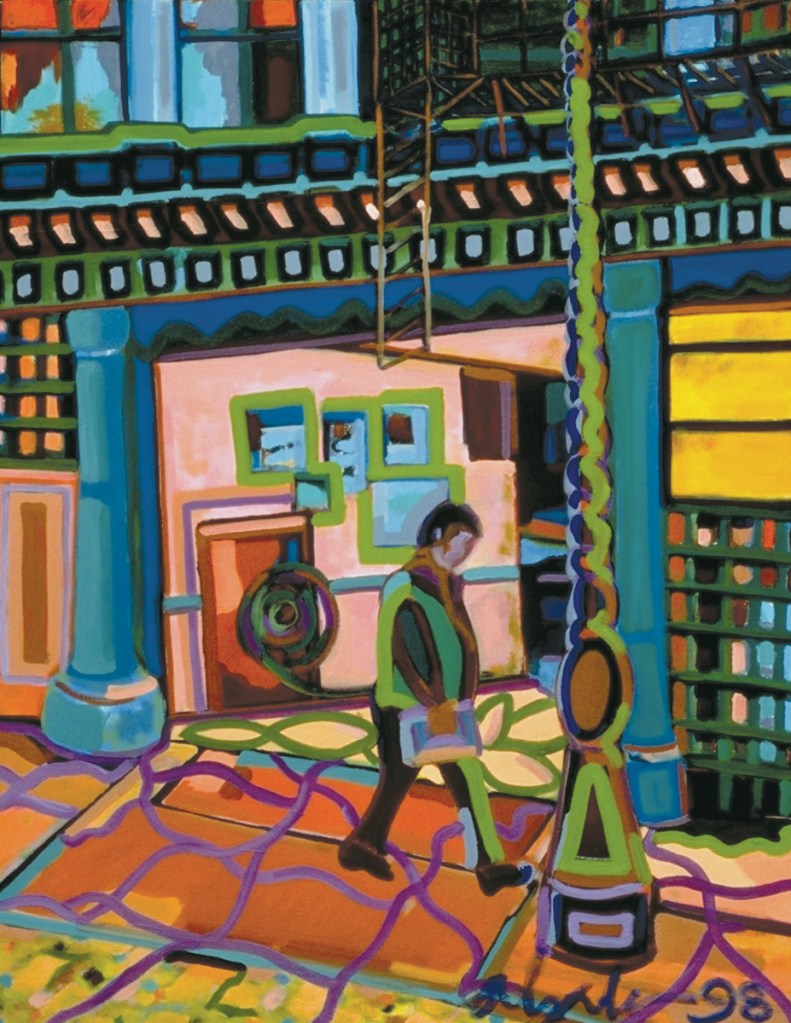
So, we’re here, and I was just thinking — no, feeling how the sight of these pieces here is connecting me to what it was like to make them, to be in the mode of noticing these places and beings: to wonder and care about them. I didn’t keep a record of where I came upon the tree, but the other place, Mercer Parking Corp., is nearby.

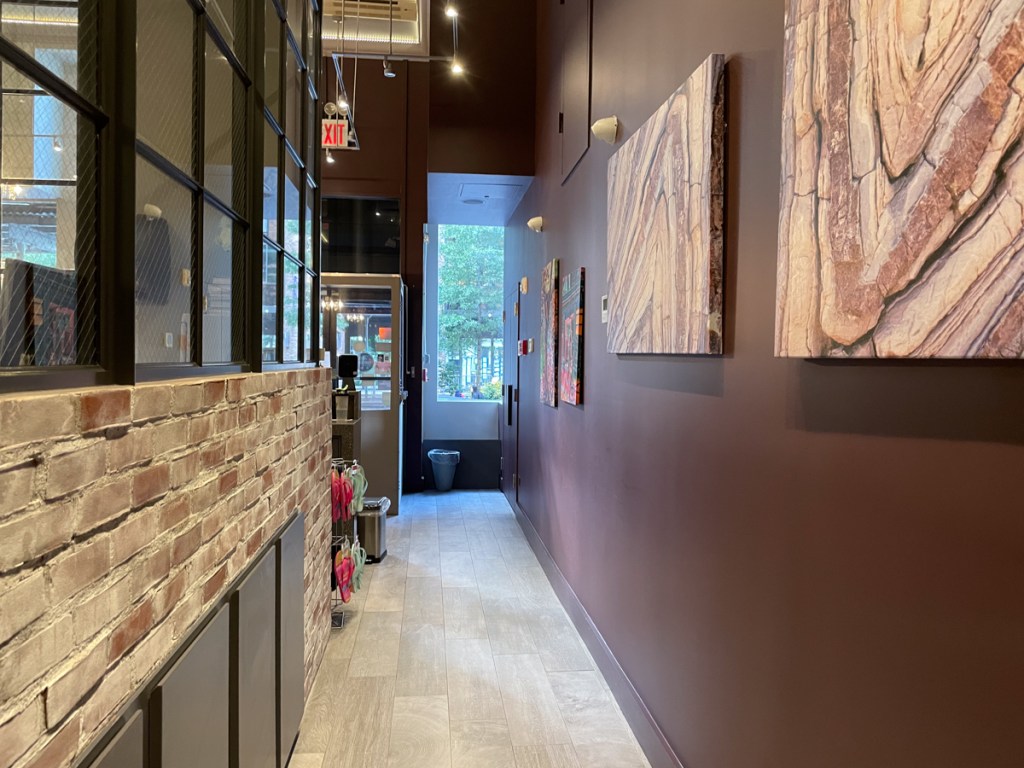
I haven’t exhibited my paintings in years. The tree has been on my living room wall, the one I face when I practice yoga in the morning, so I see it often. It’s such a different experience to see her here. Light from the front window lands on part of it; people are arriving and heading out around it, and are attended-to at the reception desk…

…just around the corner to the left past the flip flops rack.

It’s really nice to be here.


inspirations

see some art: Haven, 250 Mercer Street between 3rd and 4th Streets, NYC

Re-membering: Prentis Hemphill, “Remembering with Alexis Pauline Gumbs,” Finding Our Way, accessed February 12, 2022, https://www.findingourwaypodcast.com/individual-episodes/s1e7.

Placekeeping, storylines: Tyson Yunkaporta, Sand Talk: How Indigenous Thinking Can Save the World, Unabridged (New York: HarperAudio, 2020).

Contamination, world-making: Anna Lowenhaupt Tsing, The Mushroom at the End of the World: On the Possibility of Life in Capitalist Ruins, New paperback printing (Princeton Oxford: Princeton University Press, 2021).

Untitled (January 27th, 2024)

Dear friends,

I wanted to let you know that “Owning Auschwitz” is available to watch on YouTube.

As you may already know, “Owning Auschwitz” is a documentary about my aunt, Zypora, returning to Poland in 1998 to confirm whether she, we, my family own(s) part of the Auschwitz concentration camp. She brought documents that her mother / my grandmother had saved when she moved property into her children’s names at the end of WWII. (The story of how my grandmother got, her family [and only her family] out of Poland when she saw what was coming isn’t part of the documentary). 

A camera crew followed Zypora in and out of agencies, to the camp, to other properties, so she could see and hear for herself: was this place built on Jewish land? 

It was broadcast on 1998, and until now, I only had a VHS recording that my Dad made off the tv, and more recently, a DVD version of that.

Here’s the link: How A 60-Year-Old Jewish Widow Inherited And Reclaimed The Land Auschwitz Was Built On | Our History – YouTube

It was made available by ITV Studios on their “Our History” YouTube channel, apparently some time in November. A couple of weeks ago, Mikhail, the superintendent in my apartment building mentioned it to me as I was coming in. The story must have come up in conversation between us at some point; he started tentatively, letting me know that he wasn’t sure if he should say anything to me, and then finally said that he saw the video online, and that he remembered me telling him about my Israeli aunt, my great-grandfather’s tar factory in Poland, with large ovens to boil the tar, and railroad tracks leading into the compound…and so he thought of my family.

It’s gruesome to say it like that, conjures up hideous and horrific violence, I know. I hate saying it — it’s like a smack or sudden, raging grabbing and shaking of your whole being — but denying it, working around it, is worse for me.

This is my story.

I’ve never gotten very far into talking about it; I let it live in a kind of limbo between hating it and matter-of-factly accepting it, this blank, desolate, bizarre space inside me that I enter when I remember our connection to Auschwitz.

It’s been 25 years since my aunt decided to find out the truth, “the real” as she would say. Ever since then from time to time, it comes up, and I say the gruesome thing.

Zypora was my father’s sister. Somehow, she retained quite a bit of Polish, which amazes me. I can barely say a sentence in Hebrew. My accent is appalling — I can’t even pronounce my name, lost the ability to roll my r’s ages ago.

It’s about 50 minutes long. Sometimes they speak in Polish, and there are no subtitles, but eventually my aunt will say everything in English. She does this thing where she processes out loud (we’re definitely related), and I think she’s doing that for us watching as much as for herself.

January 27th is the International Holocaust Remembrance Day, an annual International Day of Commemoration in memory of the victims of the Holocaust – observed with ceremonies and activities at United Nations Headquarters in New York and at United Nations offices around the world. This year, 2024, is the first that I knew about this holiday.

They’re hosting Exhibition: “Fighting for the Whole World” – Lower Saxony under Nazi Rule in the Visitors’ Lobby at United Nations Headquarters through 23 February 2024. I’m going to try to see it.

I’m also planning to see this exhibition: The Drawing Center: Stéphane Mandelbaum — probably on Sunday, February 4th. “A grandson of survivors, Mandelbaum made a conscious choice to grapple with the weight of the Shoah by aggressively appropriating images of Nazis, boldly drawing them over life-size and placing them in juxtaposition with snippets of pornography, derisive caricatures, doodles, and random lists. The representation of images that most people would prefer to avoid was an act of identity-building for a young, rebellious artist hoping to shock. But it was also an act of ownership of a history that Mandelbaum refused to allow to be buried.”

Also, some work from The Holocaust Project by Judy Chicago and Donald Woodman is included in “Herstory” an exhibition of a wide range of Judy Chicago’s work, at the New Museum, until March 3rd.

And, here’s a link to an article published in the New York Times back in 1998: Hadera Journal; Jewish Family Heirloom: 15 Square Miles of Death.

How to close?

I’m sharing this now because now I can, and because over time it’s become important for me to have a better connection to my history, a clearer, more personal sense of my lineage. I really don’t have more on that…this is all still living in that blank, desolate, bizarre space inside me…this email is like a porch leading into that house.