Tag Archives: people should be seeing more art

The body, an instigator of questions

“The body, an instigator of questions”, she said. I was listening to, watching through two screens displaying one room, Dyana Gravina performing inside of it, for us. “Welcome, I can’t see you, but I know you’re there.”
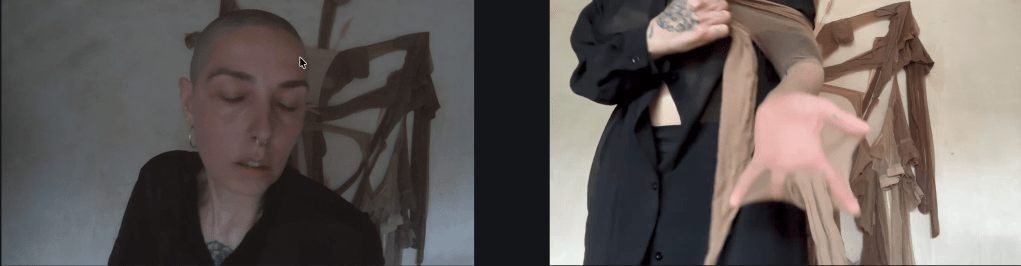
Screenshot from Dyana Gravina’s emergent performance during "Artists Talk with artist Dyana Gravina", a Feminist Lecture Program x SLQS Gallery collaboration, June 17th, 2026.
Screenshot from Dyana Gravina’s emergent performance during “Artists Talk with artist Dyana Gravina”, a Feminist Lecture Program x SLQS Gallery collaboration, June 17th, 2026.

“The body, an instigator of questions”, she said. And I —

An instigator. of questions.
Questions?
Not answers?
No, answers are stopping points. destinations.
And then what?

The body is active and so, there is always more: to consider, to wonder about, to try. to feel. Questions are openings to move into, to shape ourselves to fit into: to feel the edges of the shape, to feel the edges of ourselves. What was that?

Often there isn’t time to ask.

The body, an instigator of questions. Saying it feels like a question, like an opening, following on an exhale, slowing things down, making room for the next [breath]. an invitation.

I think that’s because we’re speaking of the body, not at the body. Listening for it. We’re in relation to the body: as subject, as agent, as knowledge bearer. And mysterious: because we speak so little of its language.

I don’t mean mysterious in a romanticized way.

There simply are many, many things about how our bodies work that we don’t understand. And misunderstand. Many people are in pain, discomfort, silenced. Questions are being asked by doctors, nurses, scientists, pharmacists. legislators. caregivers. And over time we learn. Course correct. sometimes. Discover. sometimes. Obscure. how often?

Questions have a source. And a perspective, a history. And a desire. Often these are multiple, mixed, and not necessarily clear to the bearer of them, or to us in the room. In the doctor’s examination room, our employer’s office, on the street, in our homes, in the places where we provide care to children, grandparents, parents, neighbors, where we try to take care of ourselves.

Who is asking and why?

What do they desire for us, for themselves?

What does your body want?
If you could understand it..

“The body, an instigator of questions”.

When Gravina said that. I felt it.
I felt myself a body. a woman. an instigator of questions.

—-

References and treats


Artists Talk with artist Dyana Gravina was a collaboration between The Feminist Lecture Program x SLQS Gallery. << Thank you! I am so fortunate to have been there!

Recordings of The Feminist Lecture Program artist talks (and lectures!) are available here. << So, you can see it too!

INSTAGRAMs: @dygravina @thefeministlectureprogram @slqsgallery
WEBSITEshttps://dyanagravina.com/ https://feministlectureprogram.com/ https://www.slqsgallery.com/
feeling the importance of place

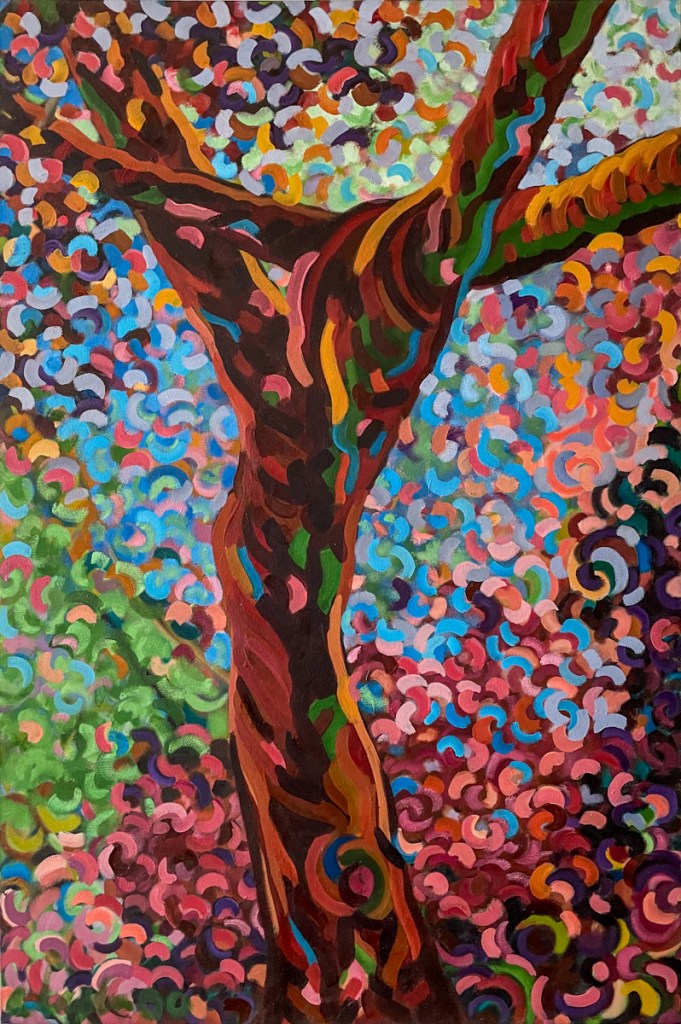
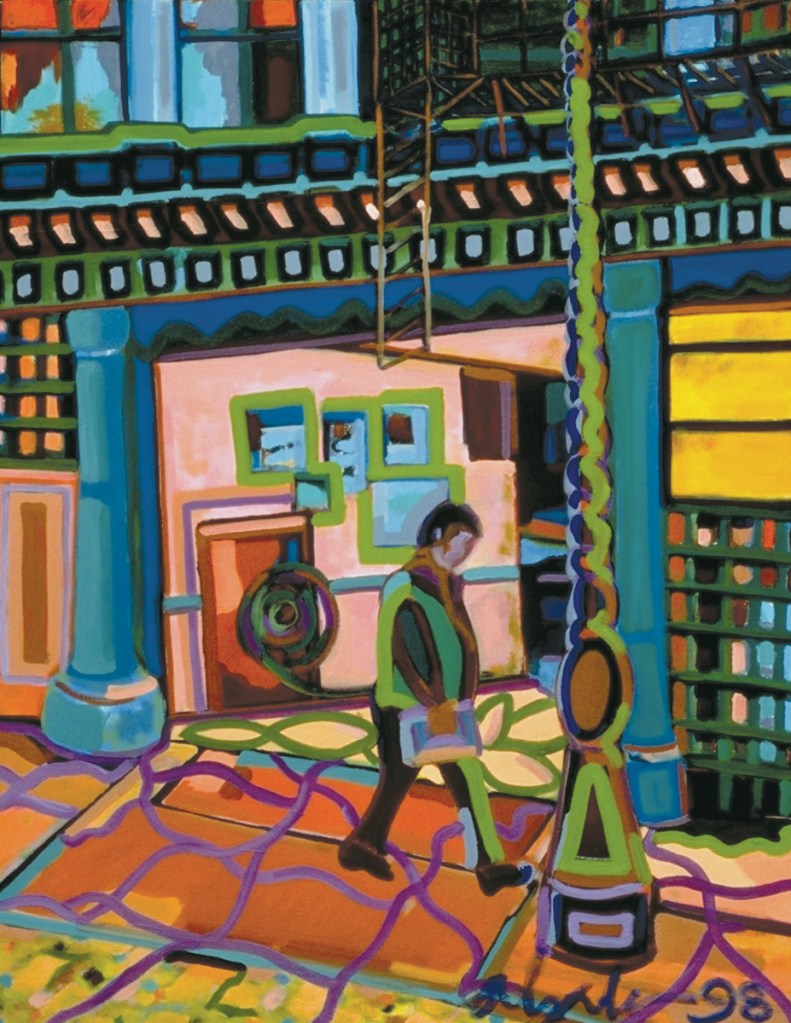
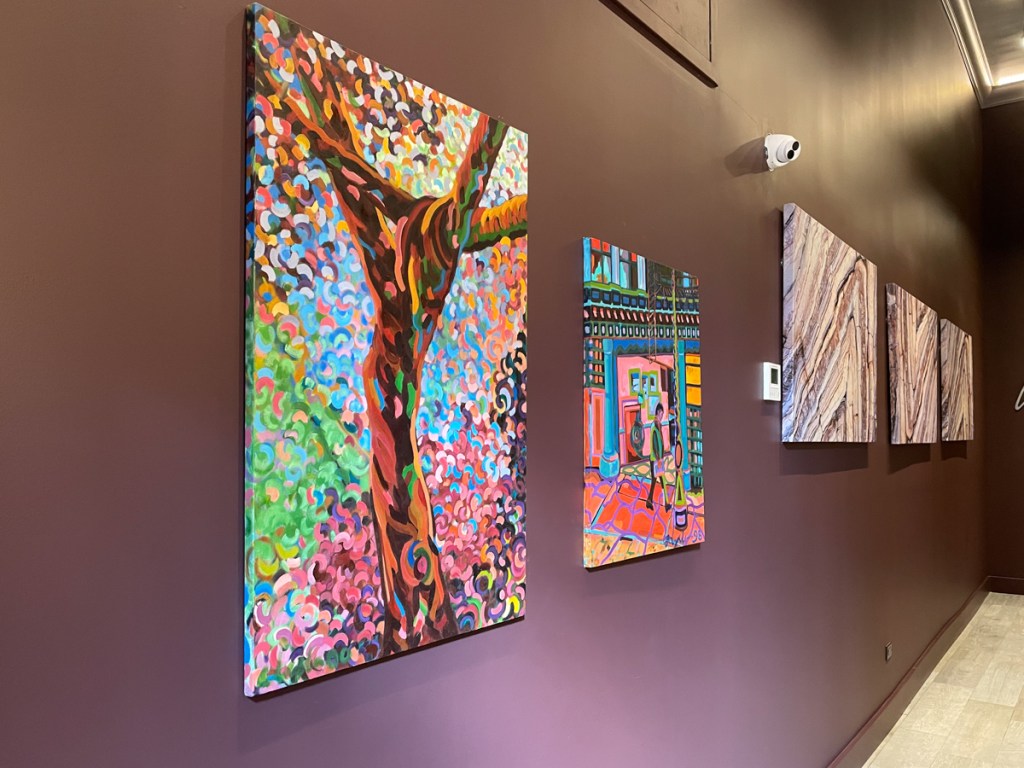
The site of these pieces here makes me so happy. People should be seeing more art. It reminds you to feel, to feel your way. For me, when I experience art that moves me: it’s a connection ritual. I remember. Even when it’s something I have never seen before, it is a re-membering, a connecting me back to my larger self: to a wordless place where being alive is enough. Proof of worth. The path forward. The way home.

It’s only recently that I’ve started thinking about – no, feeling the importance of place. Of place as a core relationship, and as the basis of all relationships.

And while there’s a there over there. And a here that is different than there, that is familiar, or mine. Or is me, where I stand. And from here, I see you where you stand. Where exactly is the edge, the border between?

If we stood here looking at these two paintings on the wall, we would be sharing breath, and of course the room. Sounds of others talking low, light music, smells (spa smells!) — And we both got here somehow. Came from somewhere, traveled on streets, on a bus or in a train probably.

There too, we were always somewhere.

It was never just us traveling alone.

It’s not just that we aren’t alone because there’s always someone around in the city. It’s the integral nature of where you are, and how you got here / there, to who you are that I’m trying to get at.

I mean the river can’t exist without the river’s edge —and more of course, it’s made and remade by the weather, and by the beings who use it, keep it alive, make it what it is, participate in what it becomes.

It’s the same for buildings on blocks in neighborhoods (which by the way, in NYC, have no official boundaries). And people. We are made and remade out of our particular relationships to a place — to the beings who use it, the forces that act on it. Its shapes, activities, and vibes shape us.

Yes, there’s still a you. You don’t need me to tell you that (actually, you are a place, and are comprised of internal places).

What I’m pointing to is the aliveness and exchange happening: the contamination. Where you are is not a background to who you are. It’s part of who you are, actively involved. You can’t strip it out. It’s like the air passing between us when we stood here looking at these two paintings on the wall.

You’re you, and I’m me, but also where is the border between us, or for that matter between you and where you are right now?

Nothing happens nowhere. Everything is situated. Every experience, idea, truth are all happening in relationship to place. But it’s not static, which can make it hard to notice; it moves -with you as memory, and becomes part of other experiences and ideas you carry. It’s taken up by others (or silenced). Even absence is tied to place.

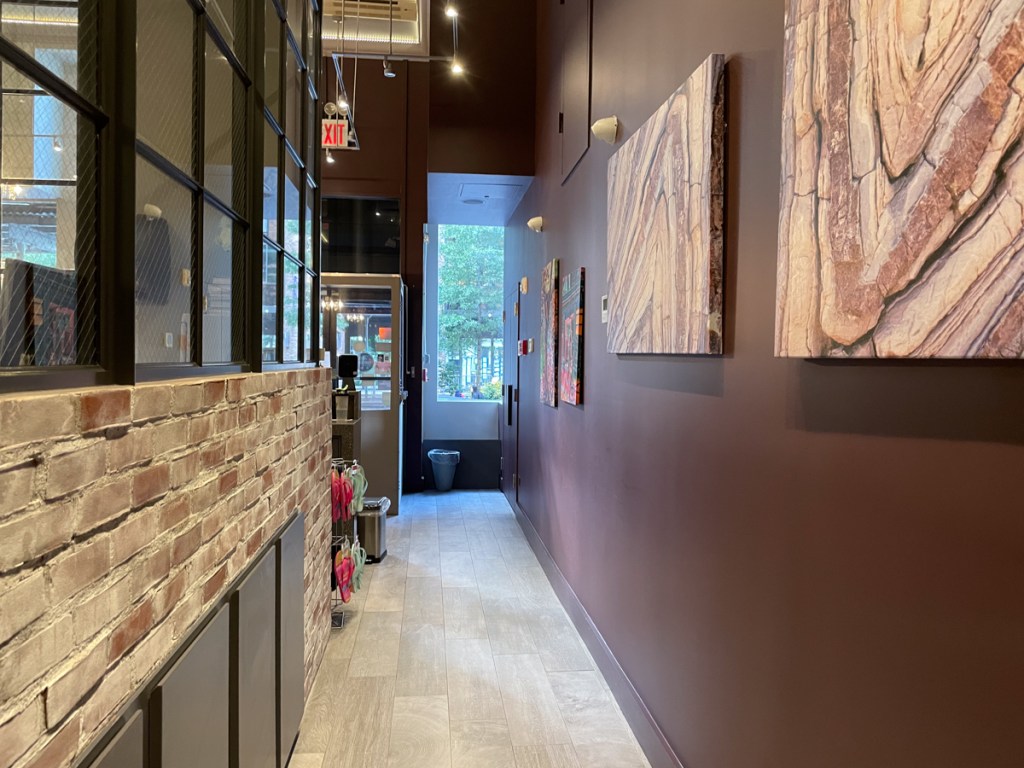
So, we’re here, and I was just thinking — no, feeling how the sight of these pieces here is connecting me to what it was like to make them, to be in the mode of noticing these places and beings: to wonder and care about them. I didn’t keep a record of where I came upon the tree, but the other place, Mercer Parking Corp., is nearby.

I haven’t exhibited my paintings in years. The tree has been on my living room wall, the one I face when I practice yoga in the morning, so I see it often. It’s such a different experience to see her here. Light from the front window lands on part of it; people are arriving and heading out around it, and are attended-to at the reception desk…

…just around the corner to the left past the flip flops rack.

It’s really nice to be here.


inspirations

see some art: Haven, 250 Mercer Street between 3rd and 4th Streets, NYC

Re-membering: Prentis Hemphill, “Remembering with Alexis Pauline Gumbs,” Finding Our Way, accessed February 12, 2022, https://www.findingourwaypodcast.com/individual-episodes/s1e7.

Placekeeping, storylines: Tyson Yunkaporta, Sand Talk: How Indigenous Thinking Can Save the World, Unabridged (New York: HarperAudio, 2020).

Contamination, world-making: Anna Lowenhaupt Tsing, The Mushroom at the End of the World: On the Possibility of Life in Capitalist Ruins, New paperback printing (Princeton Oxford: Princeton University Press, 2021).