I first came in contact with visuality, the word, on 11/09/2023, during “Birth: A Convening on Art and Human Reproduction” at the New Museum. Of course, visuality had been a guiding and deciding force in my life all along, but like the frog in a pot, I didn’t know what I didn’t know.
The birth convening was part of Judy Chicago: Herstory exhibition programming, on view at the New Museum from October 12, 2023–March 3, 2024. The exhibition filled the museum in an effort to “trace the entirety of Chicago’s practice” – what a pleasure to move through room by room (you can view installation images here). This panel focused on one project from Judy Chicago’s sixty-year career: The Birth Project.
“Why were there no images of birth?” This question inspired Judy Chicago to launch The Birth Project (1980-85). For five years, she studied creation myths, surveyed women about their birthing experiences, and produced an iconography of birth imagery across drawings, paintings, and collaboratively embroidered textiles. Now, forty years later, this convening revisits Chicago’s “awe, terror, and fascination” with birth, exploring this critical area of research and artmaking through a contemporary lens.
The panelists, Ani Liu, Carmen Winant, Dána-Ain Davis, and Viva Ruiz, in a mix of slide presentations and conversations, (moderated by Alethea Rockwell), discussed birth, abortion care and access, medical racism, maternal care in terms of visuality.
- What is the impact of the images that make it through?
- Who and what are missing from view?
- What is the impact of absence?
And I felt it: seeing is one thing; feeling it is knowing.
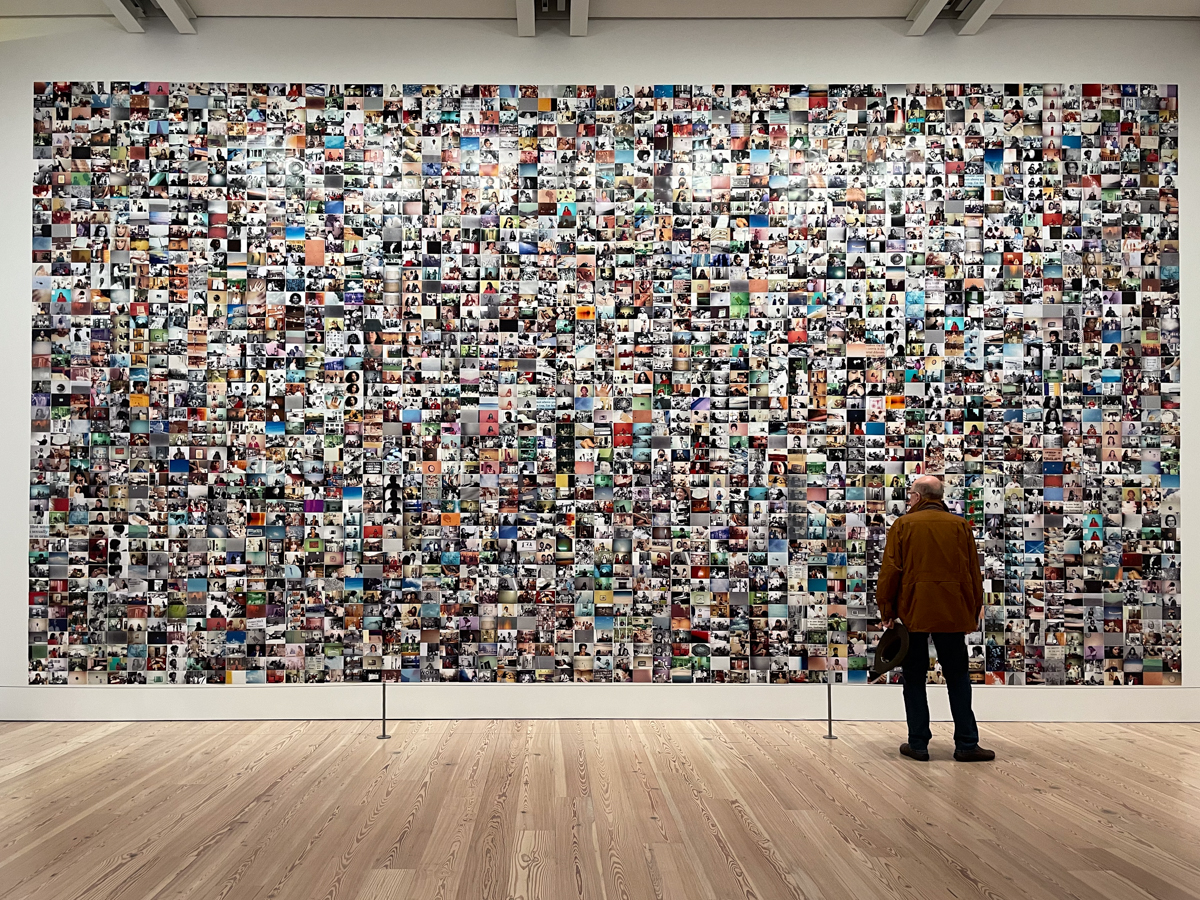
Did you know that this is what abortion work looks like? I didn’t. I hadn’t really thought about it: the images I was being fed, what it would take to run a healthcare practice.
Women on the phone, answering questions, making appointments.. Makes sense.
I see that now.
Visuality
Which images we see, in what context(s), and with what frequency, visuality defines our cultural landscape and social norms.
You don’t feel it happening.
It feels like a given.
Even when it’s inaccurate, even when it’s incomplete, even when its claims undermine your lived experience, what we see shapes our understanding, our expectations, our beliefs.
What showed up, what gained access, what got repeated: becomes part of the landscape – internally and externally. It takes shape in our minds (O, that’s what that looks like?), and shapes our minds (I know what that should look like).
It takes shape out in the world (O, that’s what that looks like?) – OK, let’s maintain it. –No, let’s get rid of it.
Visuality is not a given.
How we come to see what is true about the world is generated by many decisions along the way.
Visibility
Visibility is a feature of power. It fosters credibility and reinforces authority. Repetition is powerful. It can override what you know, overwhelm your ability to say so, or even to ask a question.

