Category Archives: Uncategorized

feeling the importance of place

The site of these pieces here makes me so happy. People should be seeing more art. It reminds you to feel, to feel your way. For me, when I experience art that moves me: it’s a connection ritual. I remember. Even when it’s something I have never seen before, it is a re-membering, a connecting me back to my larger self: to a wordless place where being alive is enough. Proof of worth. The path forward. The way home.

It’s only recently that I’ve started thinking about – no, feeling the importance of place. Of place as a core relationship, and as the basis of all relationships.

And while there’s a there over there. And a here that is different than there, that is familiar, or mine. Or is me, where I stand. And from here, I see you where you stand. Where exactly is the edge, the border between?
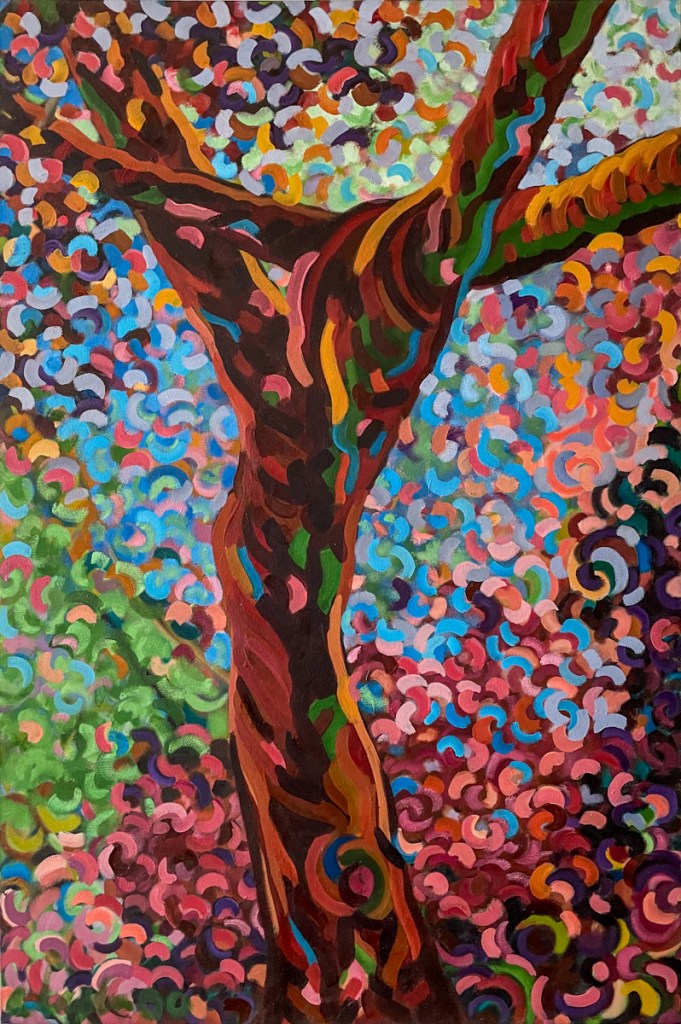
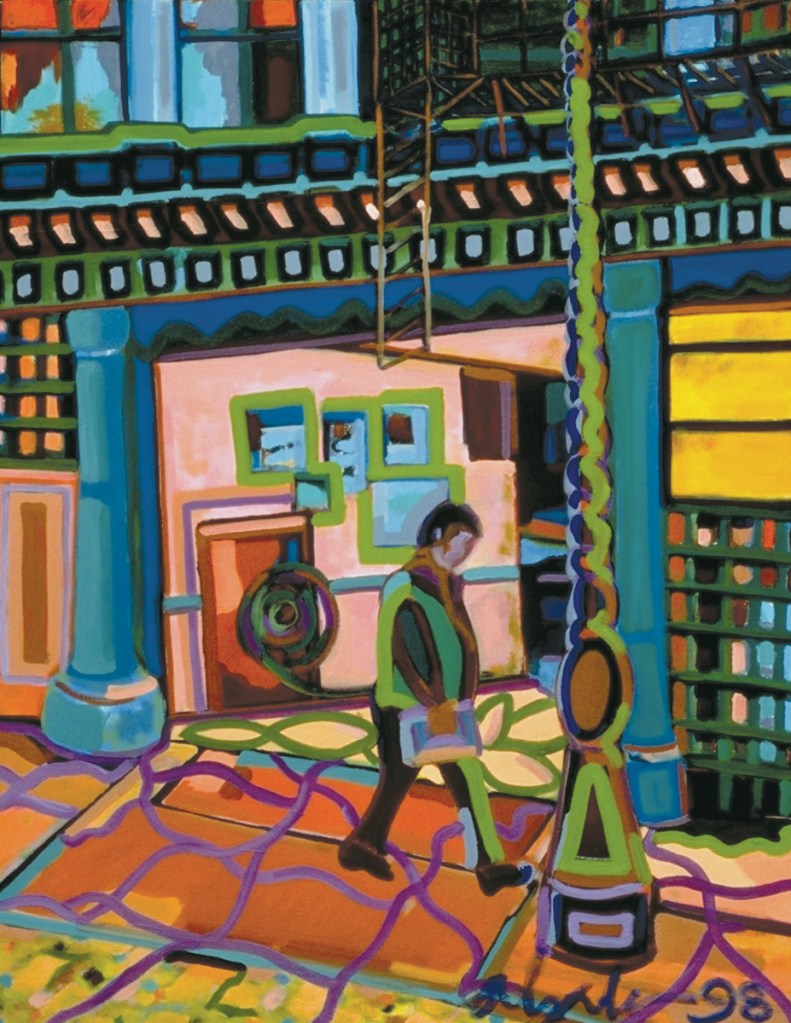
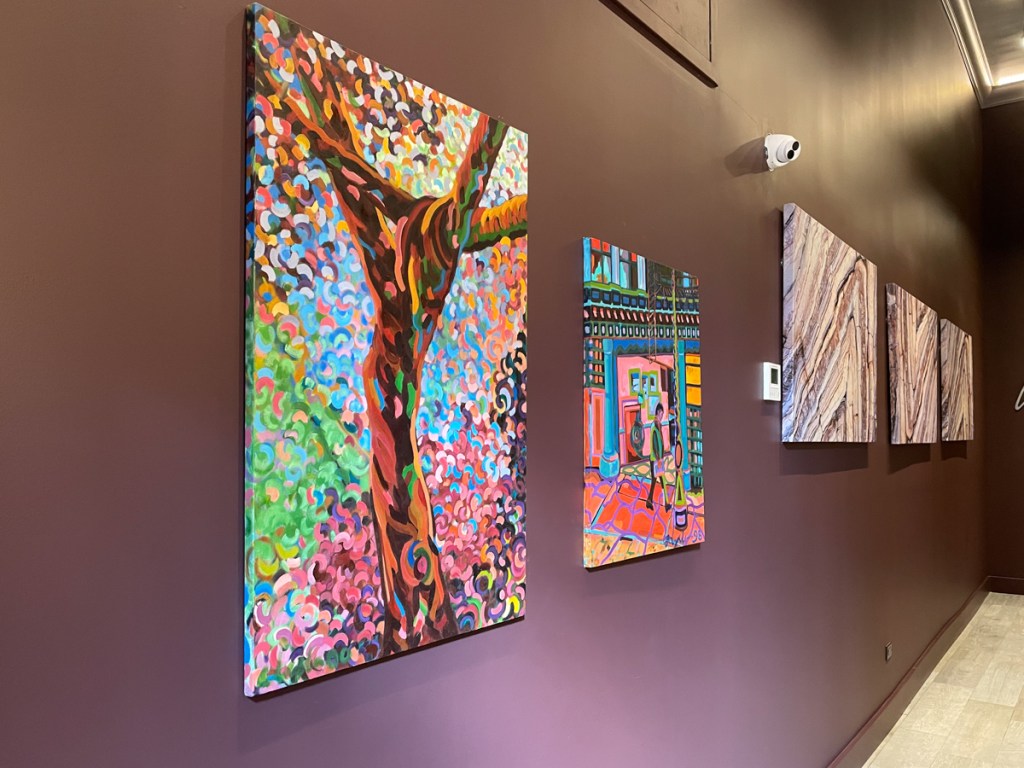
If we stood here looking at these two paintings on the wall, we would be sharing breath, and of course the room. Sounds of others talking low, light music, smells (spa smells!) — And we both got here somehow. Came from somewhere, traveled on streets, on a bus or in a train probably.

There too, we were always somewhere.

It was never just us traveling alone.

It’s not just that we aren’t alone because there’s always someone around in the city. It’s the integral nature of where you are, and how you got here / there, to who you are that I’m trying to get at.

I mean the river can’t exist without the river’s edge —and more of course, it’s made and remade by the weather, and by the beings who use it, keep it alive, make it what it is, participate in what it becomes.

It’s the same for buildings on blocks in neighborhoods (which by the way, in NYC, have no official boundaries). And people. We are made and remade out of our particular relationships to a place — to the beings who use it, the forces that act on it. Its shapes, activities, and vibes shape us.

Yes, there’s still a you. You don’t need me to tell you that (actually, you are a place, and are comprised of internal places).

What I’m pointing to is the aliveness and exchange happening: the contamination. Where you are is not a background to who you are. It’s part of who you are, actively involved. You can’t strip it out. It’s like the air passing between us when we stood here looking at these two paintings on the wall.

You’re you, and I’m me, but also where is the border between us, or for that matter between you and where you are right now?

Nothing happens nowhere. Everything is situated. Every experience, idea, truth are all happening in relationship to place. But it’s not static, which can make it hard to notice; it moves -with you as memory, and becomes part of other experiences and ideas you carry. It’s taken up by others (or silenced). Even absence is tied to place.

So, we’re here, and I was just thinking — no, feeling how the sight of these pieces here is connecting me to what it was like to make them, to be in the mode of noticing these places and beings: to wonder and care about them. I didn’t keep a record of where I came upon the tree, but the other place, Mercer Parking Corp., is nearby.

I haven’t exhibited my paintings in years. The tree has been on my living room wall, the one I face when I practice yoga in the morning, so I see it often. It’s such a different experience to see her here. Light from the front window lands on part of it; people are arriving and heading out around it, and are attended-to at the reception desk…
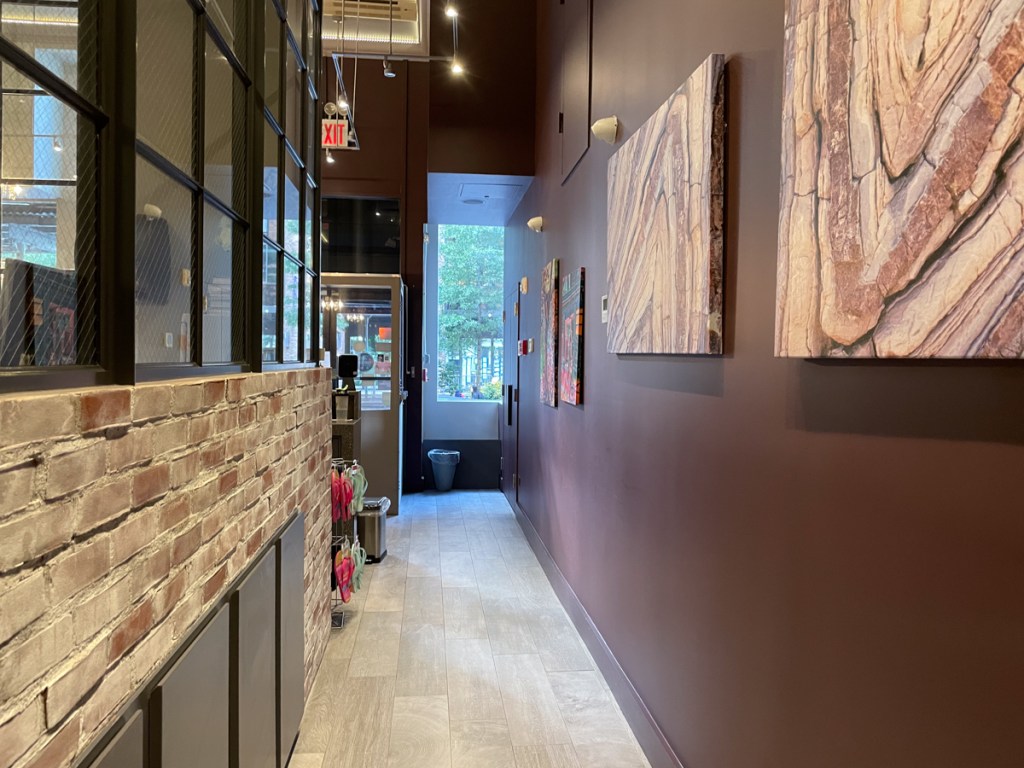
…just around the corner to the left past the flip flops rack.

It’s really nice to be here.


inspirations

see some art: Haven, 250 Mercer Street between 3rd and 4th Streets, NYC

Re-membering: Prentis Hemphill, “Remembering with Alexis Pauline Gumbs,” Finding Our Way, accessed February 12, 2022, https://www.findingourwaypodcast.com/individual-episodes/s1e7.

Placekeeping, storylines: Tyson Yunkaporta, Sand Talk: How Indigenous Thinking Can Save the World, Unabridged (New York: HarperAudio, 2020).

Contamination, world-making: Anna Lowenhaupt Tsing, The Mushroom at the End of the World: On the Possibility of Life in Capitalist Ruins, New paperback printing (Princeton Oxford: Princeton University Press, 2021).

Untitled (January 27th, 2024)

Dear friends,

I wanted to let you know that “Owning Auschwitz” is available to watch on YouTube.

As you may already know, “Owning Auschwitz” is a documentary about my aunt, Zypora, returning to Poland in 1998 to confirm whether she, we, my family own(s) part of the Auschwitz concentration camp. She brought documents that her mother / my grandmother had saved when she moved property into her children’s names at the end of WWII. (The story of how my grandmother got, her family [and only her family] out of Poland when she saw what was coming isn’t part of the documentary). 

A camera crew followed Zypora in and out of agencies, to the camp, to other properties, so she could see and hear for herself: was this place built on Jewish land? 

It was broadcast on 1998, and until now, I only had a VHS recording that my Dad made off the tv, and more recently, a DVD version of that.

Here’s the link: How A 60-Year-Old Jewish Widow Inherited And Reclaimed The Land Auschwitz Was Built On | Our History – YouTube

It was made available by ITV Studios on their “Our History” YouTube channel, apparently some time in November. A couple of weeks ago, Mikhail, the superintendent in my apartment building mentioned it to me as I was coming in. The story must have come up in conversation between us at some point; he started tentatively, letting me know that he wasn’t sure if he should say anything to me, and then finally said that he saw the video online, and that he remembered me telling him about my Israeli aunt, my great-grandfather’s tar factory in Poland, with large ovens to boil the tar, and railroad tracks leading into the compound…and so he thought of my family.

It’s gruesome to say it like that, conjures up hideous and horrific violence, I know. I hate saying it — it’s like a smack or sudden, raging grabbing and shaking of your whole being — but denying it, working around it, is worse for me.

This is my story.

I’ve never gotten very far into talking about it; I let it live in a kind of limbo between hating it and matter-of-factly accepting it, this blank, desolate, bizarre space inside me that I enter when I remember our connection to Auschwitz.

It’s been 25 years since my aunt decided to find out the truth, “the real” as she would say. Ever since then from time to time, it comes up, and I say the gruesome thing.

Zypora was my father’s sister. Somehow, she retained quite a bit of Polish, which amazes me. I can barely say a sentence in Hebrew. My accent is appalling — I can’t even pronounce my name, lost the ability to roll my r’s ages ago.

It’s about 50 minutes long. Sometimes they speak in Polish, and there are no subtitles, but eventually my aunt will say everything in English. She does this thing where she processes out loud (we’re definitely related), and I think she’s doing that for us watching as much as for herself.

January 27th is the International Holocaust Remembrance Day, an annual International Day of Commemoration in memory of the victims of the Holocaust – observed with ceremonies and activities at United Nations Headquarters in New York and at United Nations offices around the world. This year, 2024, is the first that I knew about this holiday.

They’re hosting Exhibition: “Fighting for the Whole World” – Lower Saxony under Nazi Rule in the Visitors’ Lobby at United Nations Headquarters through 23 February 2024. I’m going to try to see it.

I’m also planning to see this exhibition: The Drawing Center: Stéphane Mandelbaum — probably on Sunday, February 4th. “A grandson of survivors, Mandelbaum made a conscious choice to grapple with the weight of the Shoah by aggressively appropriating images of Nazis, boldly drawing them over life-size and placing them in juxtaposition with snippets of pornography, derisive caricatures, doodles, and random lists. The representation of images that most people would prefer to avoid was an act of identity-building for a young, rebellious artist hoping to shock. But it was also an act of ownership of a history that Mandelbaum refused to allow to be buried.”

Also, some work from The Holocaust Project by Judy Chicago and Donald Woodman is included in “Herstory” an exhibition of a wide range of Judy Chicago’s work, at the New Museum, until March 3rd.

And, here’s a link to an article published in the New York Times back in 1998: Hadera Journal; Jewish Family Heirloom: 15 Square Miles of Death.

How to close?

I’m sharing this now because now I can, and because over time it’s become important for me to have a better connection to my history, a clearer, more personal sense of my lineage. I really don’t have more on that…this is all still living in that blank, desolate, bizarre space inside me…this email is like a porch leading into that house.